




Let’s say you’ve currently got a good amount of cash to invest. $250,000 in this case. With the potential for a global financial recession after 11 Fed rate hikes since 2022 and stocks at all-time highs, investing is now getting trickier. At the same time, inflation has peaked and now the Fed is embarking on its multi-year rate cut cycle. How should one invest?
2022 was a terrible year for both stocks and bonds, but 2023 turned out to be a real winner with the S&P 500 up 24% and the NASDAQ up 43%. After a ~20% increase in the S&P 500 year-to-date, the stock market looks expensive at roughly 23X forward earnings.
On the other hand, mortgage rates are finally falling significantly. As a result, real estate demand should strengthen, potentially boosting prices up if there is normal supply. In my opinion, the greatest opportunity over the next 12-24 months lies in commercial real estate.
Despite all the volatility in recent years, the main lesson from this post is to keep on investing, no matter what.
Your capital deployment strategy may be different than mine, but so long as you keep on investing, you will likely benefit in the long run. Make your money work for you given inflation hurts your purchasing power.
If you want to be a millionaire and have over $250,000 in investable assets, take advantage and schedule a free consultation with an Empower financial professional here. Complete your two free video calls with the advisor before October 31, 2024, and you’ll receive a free $100 Visa gift card. There’s no obligation to use their services after.
After a great run in stocks, another recession could hit. It’s always a good idea to get a second opinion about how your investments are positioned, especially from a professional. If the bull market continues, you want to be properly positioned to capture the gains as well.
How I’d Invest $250,000 Cash Today
Usually, I have between $50,000 – $100,000 in my main bank account. But at one point, I accumulated over $250,000 mainly due to a $122,000 private real estate investment windfall.
In addition to accumulating cash, I also dollar-cost averaged in the S&P 500 on the way down in 2022 and way up in 2023 and 2024. I also dollar-cost averaged in Sunbelt real estate, which struggled in 2023 due to high mortgage rates. These purchases were usually in $1,000 – $5,000 increments.
I’m constantly updating this post as conditions change, so book mark it if interested. If you have less than $250,000, that’s fine too. I share the percentages of where I will allocate my money.
Background Info To Understand Our Investment Process
I’m 47 and my wife is 42. Our kids our 7 and 4. We consider ourselves moderately conservative investors since we haven’t had regular day job income since 2012 for me and 2015 for my wife.
We fear having to go back to work full-time, not because of work itself but because we fear losing our freedom to spend time with our young children. As a result, we are unwilling to take too much investment risk until both attend school full-time in fall 2024.
Although we don’t have day jobs, we do generate passive investment income to cover most of our living expenses. This is our definition of financial independence.
We also generate online income, which we usually reinvest to generate more passive income. Therefore, our cash pile will continue to build if we don’t spend or invest all the money.
Our children’s educational expenses are on track after we superfunded two 529 plans when they were born. We also have life insurance and estate planning set up.
If you have children and debt, get a term life insurance policy to protect your little ones. Both my wife and I got matching 20-year term policies during the pandemic through Policygenius. After we did, we felt a huge sense of relief.
This is not investment advice for you as everybody’s financial goals, risk tolerance, and situation are different. Please always do your own due diligence before making any investment. Your investment decisions are yours alone.
1) Treasury Bonds (35% Of Cash Holding)
Only about 3% of our net worth is in bonds, mostly individual muni bonds we plan to hold until maturity. Our target annual net worth growth rate is 3X the 10-year bond yield. We use the 10-year bond yield as the risk-free rate of return to help decide where else to invest.
The 10-year yield is currently at ~3.7% and Fed Chair Jerome Powell cut by 50 basis points on September 18, 2024. According to the ‘dot plot,’ the Federal Reserve plans to cut by a total of 100 bps in 2024 and another 100 bps in 2024. Therefore, bonds should due well.

Although locking in a 4%+ Treasury bond return won’t make us rich, it may provide you peace of mind in an upcoming recession. The yield curve has been inverted for a while.
Below is a recent bond yield table for all the various types of bonds you can buy, by duration. Notice how the Treasury bond yield curve is still inverted (short end 3-month rate is higher than the 10-year rate).

Now that we’ve deployed 35% of our cash in Treasury bonds, the remaining 64.9% of our cash will be invested in risk assets.
2) Stocks (25% Of Cash Holdings)
Roughly 18% of our net worth is in stocks after paying cash for a new house in 4Q2023. The range has fluctuated between 20% – 35% since I left work in 2012. Hence, I’m actively trying to build back my public equity exposure to around 25% of net worth.
Since I started working in equities in 1999, I’ve actually tried to regularly diversify away from stocks and into hard assets. My career and pay were already leveraged to the stock market. And I saw so many great fortunes made and lost during my time in the industry.
If you invest in growth stocks in particular, you must take some profits from time to time given they generate no income. Selling is the only way to capitalize on your gains. Otherwise, there’s no point as their value could easily correct.
We almost always front-loaded our stock purchases for the year through our kids’ Roth IRAs, custodial accounts, SEP IRAs, and 529 plans. For 25 years, I’ve always front-loaded our tax-advantaged accounts at the beginning of the year to get them out of the way.
Most of the time it works out, some of the time it doesn’t, like in 2022. That’s market timing for you. But we got to front-load our tax-advantaged investments again in 2023 and 2024, which has worked out well. Keep on investing consistently! The amounts add up over time.
In addition to maxing out all our tax-advantaged accounts, we’ve been regular contributors to our taxable online brokerage accounts. After all, in order to retire early, you need a much larger taxable investment portfolio to live off its income before age 59.5.
Stocks Seem Fully Valued
Here are the 2024 Wall Street S&P 500 forecasts with an average year-end price target of about 5,400 (up from 4,850 at the beginning of the year). In other words, there’s no upside, only downside, if the predictions come true. Although, some strategists are forecasting 5,700 – 6,000 for the year as they chase momentum. They are in the minority.
Given the situation, I’m just buying in $1,000 – $5,000 tranches of S&P 500 only after every 0.5% – 1% decline. 2024 has seen strong performance concentrated the most in seven of the biggest tech companies. The forward P/E of the S&P 500 is now about ~23X, higher than its 17X long-term average.
If there is another correction of 5% – 10%, like we had starting July 16, 2024, I am doubling my investment in stocks to $2,000 – $10,000 per buy. I believe in a soft economic landing, not a hard landing. As a result, I’m taking advantage of the dips.
Here is a post that provides a framework for your stock allocation by bond yield. The higher risk-free bond yields go, the lower your stock allocation is recommended to be and vice versa. With Treasury bond yields declining, the opportunity cost of not holding them also goes down.
If I was in my 20s and 30s, I would allocate 50% of my cash to buying stocks instead of just 25%. The remaining 25% would go to online real estate as the sector rebounds, 15% to venture capital funds, and only 10% would go to Treasuries and education. Remember, every investment is based off an individual’s personal financial situation and goals.
Below are the latest 2024 S&P 500 Wall Street forecasts.

3) Venture Capital (15% Of Cash Holding)
I enjoy investing in private funds because they are long-term investments with no day-to-day price updates. As a result, these investments cause little stress and are easy to forget about. Private investing forces you to invest for the long run as you meet capital calls over the years of deployment.
I’ve already made capital commitments to a couple closed-end venture capital funds and a venture debt fund. As a result, I will just keep contributing to these funds whenever there are capital calls.
Venture capital is making a comeback in 2024 given private company valuations took a hit since 2022. Capital often rotates toward the biggest underperforming asset classes. Since November 2023, I’ve witnessed a significant uptick in capital calls as private funds start putting their committed cash to work.
Investing In Artificial Intelligence
I’m excited about investing in artificial intelligence, one of the biggest investment opportunities over the next decade. My closed-end VC funds are actively making AI investments. But these funds are invite only with $100,000+ minimums.
Thankfully, Fundrise introduced their Fundrise venture capital product at the end of 2022, which was at the bottom of the private market downturn. Fundrise was able to invest in private growth company is a reasonable valuations, many of which have not re-rated higher yet on the books. Once these companies do raise a new round of funding or go IPO, given their continued growth, there could be upside potential in valuation.
Fundrise invests in private growth companies, especially in the artificial intelligence space. I ended up investing $143,000 in Fundrise’s venture product. The investment minimum is only $10 and the product is open to all.
20 years from now, I don’t want my kids asking me why I didn’t invest in AI or work in AI given I had a chance to near the beginning. By investing in funds that invest in AI, at least I’ll be able to benefit if I can’t get a job in AI.
Here’s a discussion I had with Ben Miller, CEO of Fundrise, about artificial intelligence and investing in growth companies. Roughly 75% of the venture capital product is invested in AI companies.
4) Real Estate (24.9% Of Cash Holding)
I’m bullish on real estate in 2024 and 2025 as the sector plays catch-up to stocks. With mortgage rates aggressively coming down and pent-up demand building, prices should move higher. As a result, I’m actively buying real estate funds today.
Real estate is my favorite asset class to build wealth for the average person. It provides shelter, generates income, and is less volatile. Unlike with some stocks, real estate values just don’t decline by massive amounts overnight due to some small earnings miss. Real estate accounts for about 50% of our net worth.
Here are the 2024 housing price forecasts by industry experts. With the stock market up so much, pent-up demand building, and mortgage rates coming down, I expect home prices to rise by 4.5% or more in 2024 and by another 3% in 2025.
In areas like San Francisco, where big tech and AI is booming, home prices could rise much greater than the national average. So far in 2024, there has been a double digit percentage rebound in home prices do too intense bidding wars in the spring.
There is always a cyclical slowdown during the second half of the year, which presents a buying opportunity. I firmly believe there will be even stronger bidding wars in the Spring of 2025.

Strategically Investing In Real Estate Online
I will continue to dollar-cost average into private real estate funds like Fundrise that invest in single-family homes and industrial properties in the Sunbelt. Valuations tend to be lower and yields tend to be higher in non-coastal states.
Depending on where you are in the country, prices and rents are down 3%-18% from the highs, hence the opportunity to buy now at lower prices. Sunbelt real estate should be a long-term beneficiary of demographic trends, technology, and work from home.
With the stock market up so much, investors are going to logically convert some of their funny money gains into real assets. For commercial real estate, we are past the bottom with attractive prices currently. Big firms such as Blackstone are actively investing in commercial real estate today.
You want to be investing in real estate at the beginning of a multi-year interest rate cut cycle, which is starting now.

5) Debt Pay Down (0% Of Cash Holding)
With the Treasury bond yields still higher than the average 30-year fixed mortgage rate, paying down mortgage debt is a suboptimal move.
If you have debt, consider following my FS DAIR investing and debt pay down framework. It gives you a logical framework recommending how much of your cash flow you should use to pay down debt or invest.
If you do decide to aggressively pay down debt, just make sure you don’t compromise your liquidity too much in any market. Always have at least six months of living expenses in cash. You never know when a downturn will come.
6) Financial Education (0.1% of Cash Holding)
Education is one of the best long-term investments. The paradox of education is it is extremely important to help you build wealth, yet it is also inexpensive or free today. Rich people are reading all the time. Poor people are watching TV all the time!
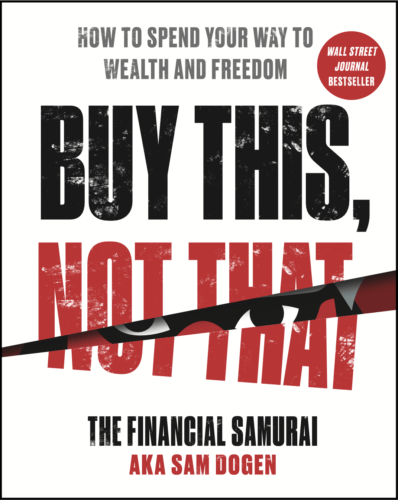
For only $18 after tax you can order my WSJ bestseller, Buy This, Not That and immediately gain a competitive advantage to building wealth. You’ll also learn how to make more optimal decisions on some of life’s biggest dilemmas. Due to enormous demand, the book is now and it’s 4th print with updated figures and pictures.
If you want to learn how to negotiate a severance and be free from a job you dislike, then read How To Engineer Your Layoff. A severance package was my #1 catalyst to leave finance behind in 2012. I haven’t returned to work since thanks to receiving a six-figure severance package. Freedom is priceless. Use the code “saveten” at checkout to save $10.
You could also join 70,000+ others and subscribe to my free weekly newsletter and my free blog posts to stay on top of timely financial topics. I’ve been publishing three posts a week since July 2009.
You can also subscribe to my podcast on Apple or Spotify. The more you immerse yourself in money topics, the more you will learn and take appropriate action to help boost your wealth.
Finally, can also go to YouTube, Khan Academy, or MOOC and watch hundreds of hours of free educational videos. Or you can pay for online courses to get even deeper into a subject.
Ignorance is no longer an excuse given how accessible education is today. Over time, the combination of experience and education will dramatically improve your confidence, wealth, and peace of mind.
Keep On Investing For The Long Term
The key to becoming a successful investor is to consistently invest for the long term. While you will encounter corrections and bear markets along the way, over the long term, risk assets such as stocks and real estate have historically yielded positive real returns.
However, it’s essential not to lose sight of the purpose behind your investments. If your gains are sufficient to cover your intended goals, it’s acceptable to consider selling. The objective is not to accumulate money endlessly but rather to utilize your funds to enhance your quality of life.
Personally, I’m investing to:
- Give my family the best life possible
- Pay for expensive college tuition starting in 2035 and 2038
- Maintain the freedom I’ve had from full-time work since 2012
- Take care of my parents if needed
- Have a comfortable retirement lifestyle
- Comfortable afford to travel internationally now that my youngest is almost 5 and can form strong memories
- Give back to my favorite non-profit organizations such as the Pomeroy Center for those with special needs
- Continue writing and recording on Financial Samurai freely
Diversify Into Real Estate And Venture Capital
To invest in real estate more strategically, check out Fundrise. Fundrise runs over $3.3 billion across multiple funds for over 500,000 investors that primary invest in the Sunbelt region where valuations are lower and yields are higher. I expect the real estate market to rebound as mortgage rates come down.
To invest in private growth companies, check out the venture capital at Fundrise. The product invests in private companies in the artificial intelligence, prop tech, fin tech, and datacenter space. Private companies are staying private for longer, meaning more gains are accruing to the private investor.
Fundrise is a long-time sponsor of Financial Samurai and Financial Samurai has invested over $275,000 in Fundrise products.
Get A Free, No-Obligation Financial Consultation
Empower is offering a free financial consultation with no obligation. If you have over $250,000 in investable assets, take advantage and schedule an appointment with an Empower financial advisor here. Complete your two video calls with the advisor before October 31, 2024, and you’ll receive a free $100 Visa gift card.
In 2013, I had a free consultation with an Empower financial advisor that helped me identify a significant financial blind spot. At the time, I was conservative, holding a 52% cash allocation in my taxable portfolio after leaving my job the previous year.
In my mind, I had to invest like a traditional 65-year-old retiree. The advisor pointed out that I was still young (35) with many financial opportunities ahead. Following that advice, I invested my cash into stocks and real estate, which has paid off well over the past 11+ years.
The statement is provided to you by Financial Samurai (“Promoter”) who has entered into a written referral agreement with Empower Advisory Group, LLC (“EAG”). Click here to learn more.


